Strategy Design Patterns
AlphaForge is a development and validation platform built for users to grow their own strategies. The distributed binary ships a curated set of 7 strategies (4 basic + 1 range + 2 advanced-indicator references), and this page is a collection of design patterns for assembling your own strategy JSON on top of them.
How to read this page
- The IDs of the 7 built-in strategies are listed in the CLI reference: alpha-forge strategy.
- The JSON examples on this page are written as templates for building your own custom strategy; the
strategy_idvalues use placeholdermy_*names. Replace them with meaningful names of your own and register viaalpha-forge strategy save. - Backtest result numbers are illustrative. Actual values depend on data and environment (fetch period, provider, settings).
Three design patterns on this page
| Pattern | Strategy type | Key indicators | Learning focus |
|---|---|---|---|
| HMM × BB × RSI | Regime-adaptive mean reversion | HMM / BBANDS / RSI | HMM regime detection + intermediate variables design |
| Regime switching | Per-regime strategy switching | HMM / SUPERTREND / BBANDS / RSI | Switching entry / exit / risk per regime via regime_config |
| Multi-timeframe | Higher-TF trend × daily entry | Weekly SMA / RSI / ATR | MTF confluence with indicators[].timeframe |
These go one step beyond the built-in hmm_bb_pipeline_v1 (HMM example) and donchian_turtle_v1 (classic Turtle trend follower) shipped with the binary, and serve as design guidance when you "start from the 7 built-ins and customize."
Strategy JSON basics
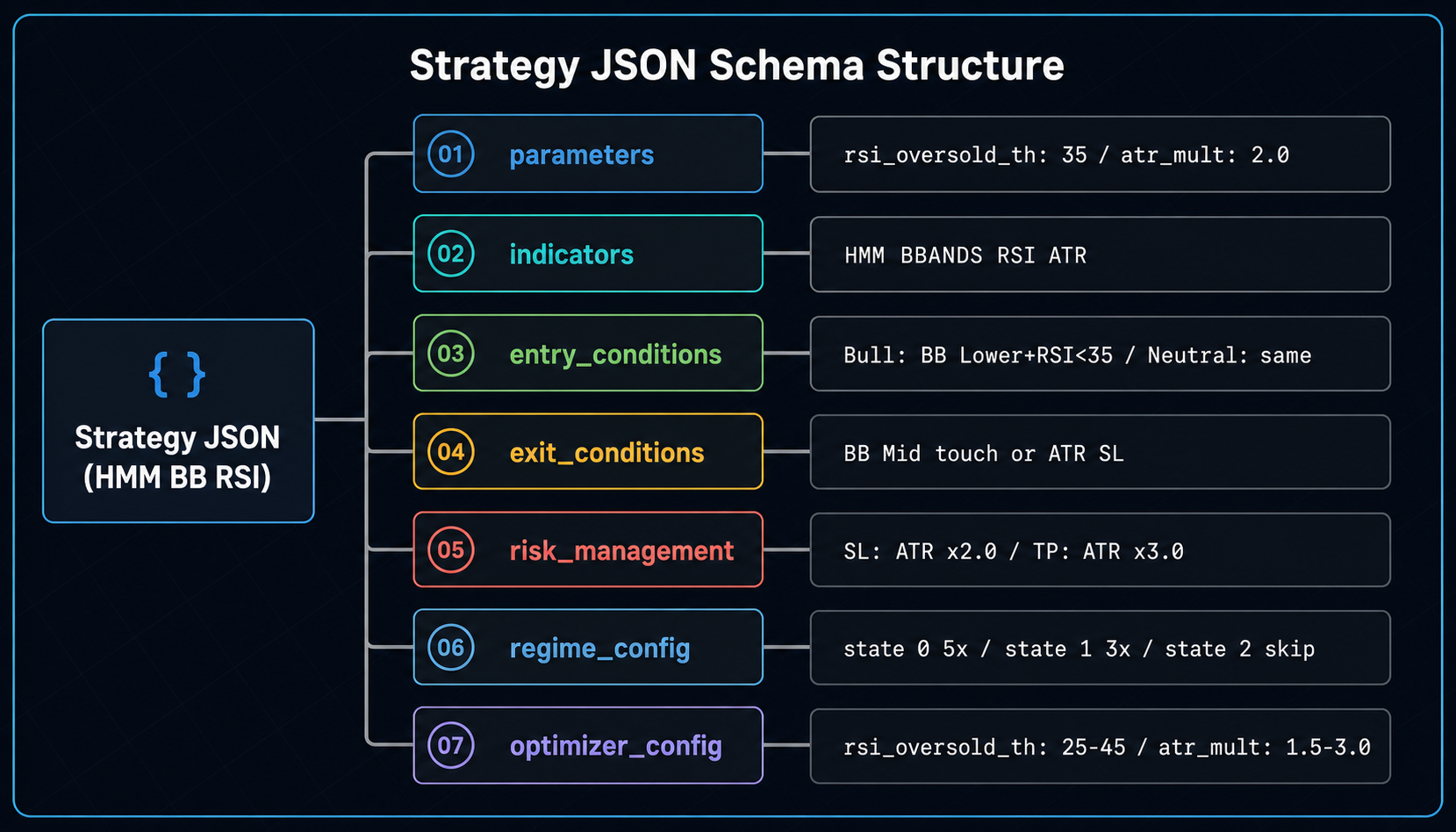
Every strategy follows the same Pydantic schema. Indicator details are available via alpha-forge analyze indicator list.
{
  "strategy_id": "...",
  "name": "...",
  "target_symbols": [...],
  "asset_type": "stock",
  "timeframe": "1d",
  "parameters": {...},          // Top-level parameters subject to optimization
  "indicators": [...],          // Computed indicators (30+ types)
  "variables": [...],           // Intermediate boolean variables (optional)
  "entry_conditions": {...},    // Entry conditions
  "exit_conditions": {...},     // Exit conditions
  "risk_management": {...},     // Position size, SL/TP
  "regime_config": {...},       // Regime adaptation (optional)
  "optimizer_config": {...}     // Optimization parameter ranges
}
About schema_version (schema generation, issue #1175)
A strategy JSON may carry an integer schema_version that denotes the schema generation for product management (distinct from the free-form user version field). It is checked on load, and JSON with a schema_version newer than the current CLI is rejected with an explicit error, prompting you to update the CLI. Older versions or no version at all (including existing JSON without a schema_version key) are read with backward compatibility, so you do not need to add it manually.
Key concepts:
indicators[].lock_on_entry: true— Freeze the value at the entry bar (used for SL/TP prices)indicators[].timeframe: "1w"— Pull values from a higher timeframe (multi-timeframe)EXPRindicator — Arbitrary pandas expression (e.g.,"close * 0.98")HMMindicator — Hidden Markov Model regime detectionregime_config— Switchentry/exit/risk_overrideper regime, keyed on the HMM output
HMM × BB × RSI
Overview
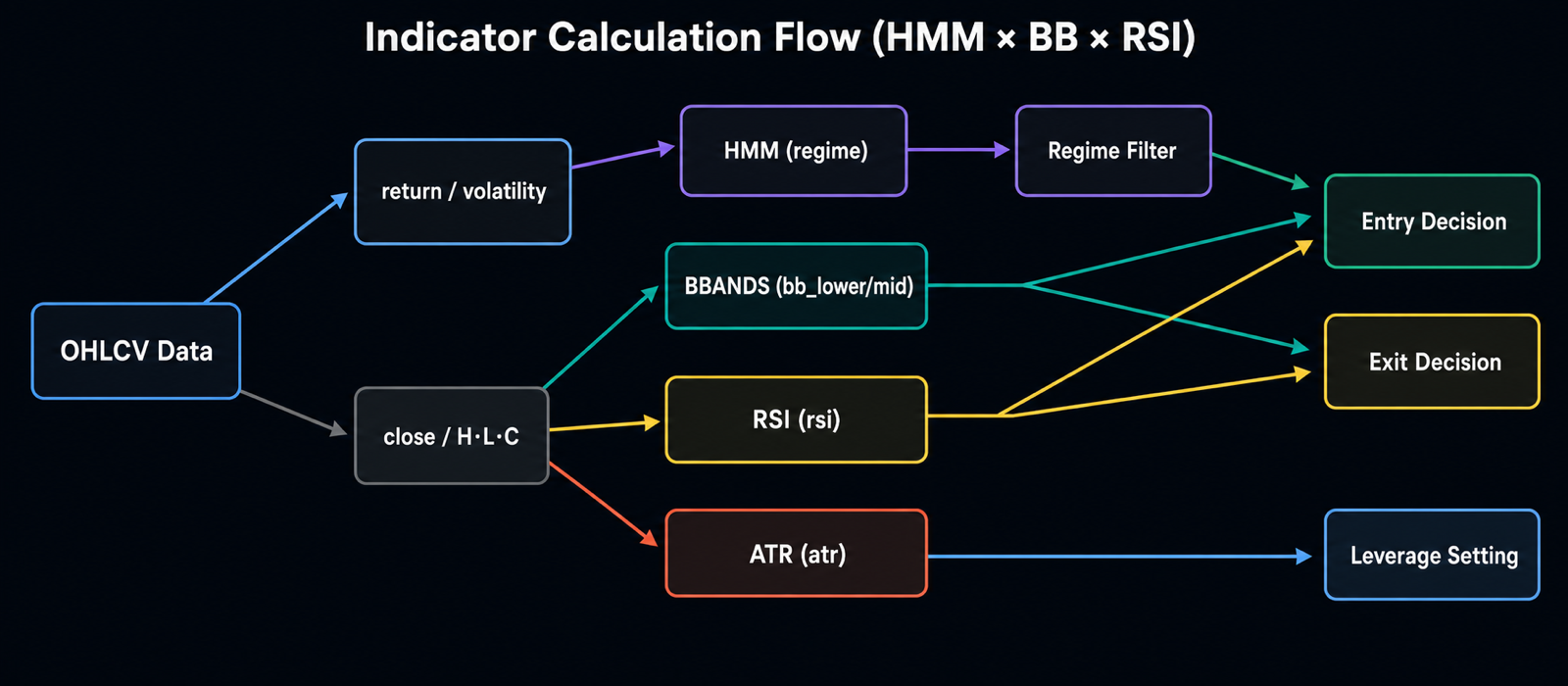
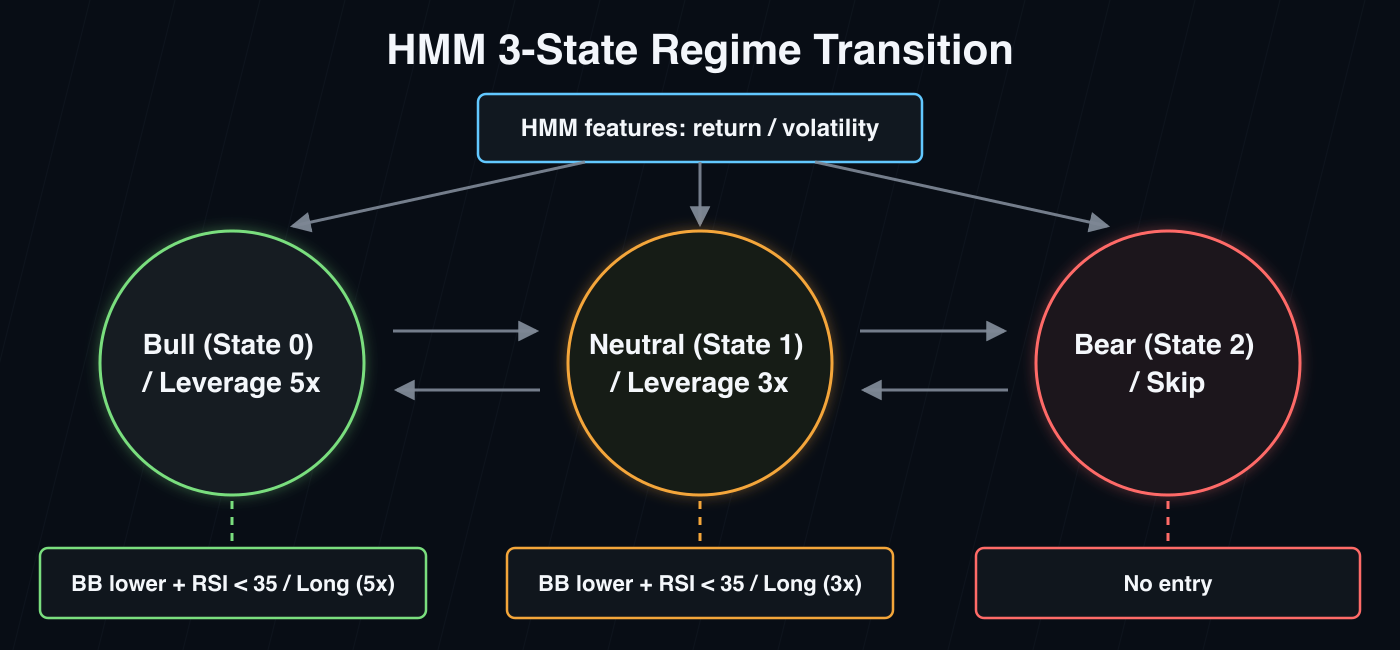
Mean-reversion entries triggered by Bollinger Band lower break + RSI oversold, filtered through a 3-state HMM regime detector. Bull/Neutral/Bear regimes are distinguished, with aggressive leverage in Bull (5x), conservative in Neutral (3x), and skip in Bear.
The strength of this template is managing three regimes within a single strategy JSON. A mean-reversion strategy that works in range markets is automatically muted (or fully paused) when trends are too strong or too weak — keeping drawdowns under control.
Suitable scenarios
- Symbols: US large-cap ETFs (QQQ, SPY), growth stocks (NVDA), instruments with low long-horizon transaction costs
- Market environment: Mid-to-long-term regimes alternating between trend and range (like 2018-2025)
- Holding period: Days to ~2 weeks
- Risk profile: Leverage-friendly (up to 5x); HMM mis-detection can amplify drawdowns
Strategy JSON (full)
{
  "strategy_id": "my_hmm_bb_rsi_v1",
  "name": "Multi-Asset HMM×BB+RSI v1 (QQQ)",
  "version": "1.0.0",
  "description": "HMM 3-state regime filter × BB+RSI mean reversion. Bull(state=0): long on BB-lower + RSI oversold (leverage=5). Neutral(state=1): same condition (leverage=3). Bear(state=2): skip. Daily.",
  "target_symbols": ["QQQ"],
  "asset_type": "stock",
  "timeframe": "1d",
  "parameters": {
    "rsi_oversold_th": 35,
    "atr_mult": 2.0
  },
  "indicators": [
    { "id": "regime",   "type": "HMM",     "params": { "n_components": 3, "features": ["return", "volatility"] } },
    { "id": "bb_lower", "type": "BBANDS",  "params": { "length": 20, "std": 2.0, "line": "lower" } },
    { "id": "bb_mid",   "type": "BBANDS",  "params": { "length": 20, "std": 2.0, "line": "mid" } },
    { "id": "rsi",      "type": "RSI",     "params": { "length": 7 } },
    { "id": "atr",      "type": "ATR",     "params": { "length": 14 } },
    { "id": "sl_dist",  "type": "EXPR",    "params": { "expr": "atr * atr_mult" }, "lock_on_entry": true }
  ],
  "variables": [],
  "entry_conditions": { "long": { "logic": "AND", "conditions": [] } },
  "exit_conditions":  { "long": { "logic": "OR",  "conditions": [] } },
  "risk_management": {
    "leverage": 5.0,
    "position_sizing_method": "fixed",
    "position_size_pct": 100.0,
    "stop_loss_indicator": "sl_dist",
    "max_positions": 1
  },
  "regime_config": {
    "indicator_id": "regime",
    "default_action": "skip",
    "states": {
      "0": {
        "entry_conditions": { "long": { "logic": "AND", "conditions": [
          { "left": "close", "op": "<", "right": "bb_lower" },
          { "left": "rsi",   "op": "<", "right": "rsi_oversold_th" }
        ]}},
        "exit_conditions":  { "long": { "logic": "OR",  "conditions": [
          { "left": "close", "op": ">", "right": "bb_mid" }
        ]}},
        "risk_override": { "leverage": 5.0, "position_sizing_method": "fixed", "position_size_pct": 100.0 }
      },
      "1": {
        "entry_conditions": { "long": { "logic": "AND", "conditions": [
          { "left": "close", "op": "<", "right": "bb_lower" },
          { "left": "rsi",   "op": "<", "right": "rsi_oversold_th" }
        ]}},
        "exit_conditions":  { "long": { "logic": "OR",  "conditions": [
          { "left": "close", "op": ">", "right": "bb_mid" }
        ]}},
        "risk_override": { "leverage": 3.0, "position_sizing_method": "fixed", "position_size_pct": 100.0 }
      },
      "2": {}
    }
  },
  "backtest_config": {
    "regime_analysis": {
      "method": "hmm",
      "hmm_indicator_id": "regime",
      "label_names": { "0": "Bull", "1": "Neutral", "2": "Bear" }
    }
  },
  "optimizer_config": {
    "param_ranges": {
      "bb_lower.length": { "min": 15,  "max": 25,  "step": 1 },
      "bb_lower.std":    { "min": 1.8, "max": 2.5, "step": 0.1 },
      "rsi.length":      { "min": 5,   "max": 14,  "step": 1 },
      "rsi_oversold_th": { "min": 25,  "max": 45,  "step": 5 },
      "atr_mult":        { "min": 1.5, "max": 3.0, "step": 0.5 }
    },
    "constraints": { "min_trades": 20 },
    "metric": "sharpe_ratio"
  },
  "tags": ["hmm", "bb", "rsi", "mean-reversion", "leverage", "nas100"]
}
Key parameters
| Parameter | Role | Recommended range |
|---|---|---|
regime.n_components |
HMM state count | 3 (Bull/Neutral/Bear) |
regime.features |
HMM input features | ["return", "volatility"] |
bb_lower.length / std |
BB period and std multiplier | period 15-25, std 1.8-2.5 |
rsi.length |
RSI period | 5-14 (shorter = more responsive) |
rsi_oversold_th |
Entry threshold | 25-45 (lower = stricter) |
atr_mult |
ATR-based SL multiplier | 1.5-3.0 |
risk_override.leverage |
Per-regime leverage | Bull 5.0 / Neutral 3.0 / Bear 0 (skip) |
Sample backtest output
Sample output
Numbers depend on data and environment.
==> QQQ 2018-01-01 → 2025-12-31 (1d)
   trades: 38   win_rate: 65.8%   profit_factor: 2.15
   total_return: +124.5%   cagr: +10.7%   sharpe: 1.42
   max_drawdown: -18.4%   exposure: 24.3%
   final_equity: $22,450  (initial: $10,000)
Customization tips
- Change the symbol: Replace
target_symbolswith["SPY"],["NVDA"],["GC=F"], etc. - Change state count:
regime.n_components: 2(Bull/Bear) simplifies the decision;4adds nuance (requires more data) - Strengthen entry: Add
volume > sma_volume_20or similar conditions inregime_config.states["0"].entry_conditions - Optimize:
alpha-forge optimize run QQQ --strategy my_hmm_bb_rsi_v1 --metric sharpe_ratio --save
Regime switching
Overview
A pattern that applies different strategies per regime, keyed on HMM output. Within a single strategy JSON, the Bull regime runs trend-following and the Bear/Range regime runs mean reversion — swapping the strategy itself rather than just parameters.
The defining feature versus HMM × BB × RSI: regime_config.states lets you define entry_conditions and exit_conditions completely independently per regime.
Suitable scenarios
- Symbols: Commodity futures (CL=F, GC=F, NG=F) — high-volatility instruments with clear trend/range alternation
- Market environment: Capture both trend and counter-trend behavior typical of commodity markets
- Holding period: Days to a month
- Risk profile: High leverage (10x) + ATR-based SL; assumes margin-based commodity trading
Strategy JSON (full)
{
  "strategy_id": "my_regime_switching_v1",
  "name": "Commodity HMM Regime v1",
  "version": "1.0.0",
  "description": "Regime-adaptive for commodity CFDs: HMM 2-state Bull/Bear. Bull = SuperTrend long, Bear = BB+RSI mean reversion. leverage=10.",
  "target_symbols": ["GC=F", "SI=F", "CL=F", "BZ=F", "NG=F", "ZC=F", "ZS=F", "ZW=F", "HG=F"],
  "asset_type": "stock",
  "timeframe": "1d",
  "parameters": {
    "adx_threshold": 20,
    "rsi_threshold": 35,
    "atr_mult": 2.0
  },
  "indicators": [
    { "id": "regime",         "type": "HMM",        "params": { "n_components": 2, "features": ["return", "volatility"], "volatility_window": 10 } },
    { "id": "supertrend_val", "type": "SUPERTREND", "params": { "length": 9, "multiplier": 3.0 } },
    { "id": "adx_val",        "type": "ADX",        "params": { "length": 14 } },
    { "id": "bb_lower",       "type": "BBANDS",     "params": { "length": 20, "std": 2.0, "line": "lower" } },
    { "id": "bb_mid",         "type": "BBANDS",     "params": { "length": 20, "std": 2.0, "line": "mid" } },
    { "id": "rsi",            "type": "RSI",        "params": { "length": 14 } },
    { "id": "atr",            "type": "ATR",        "params": { "length": 14 } },
    { "id": "sl_dist",        "type": "EXPR",       "params": { "expr": "atr * atr_mult" }, "lock_on_entry": true }
  ],
  "variables": [],
  "entry_conditions": { "long": { "logic": "AND", "conditions": [] } },
  "exit_conditions":  { "long": { "logic": "OR",  "conditions": [] } },
  "risk_management": {
    "leverage": 10.0,
    "position_sizing_method": "risk_based",
    "risk_per_trade_pct": 1.5,
    "stop_loss_indicator": "sl_dist",
    "max_positions": 1
  },
  "regime_config": {
    "indicator_id": "regime",
    "states": {
      "0": {
        "entry_conditions": { "long": { "logic": "AND", "conditions": [
          { "left": "close",   "op": "crosses_above", "right": "supertrend_val" },
          { "left": "adx_val", "op": ">",             "right": "adx_threshold" }
        ]}},
        "exit_conditions":  { "long": { "logic": "OR",  "conditions": [
          { "left": "close", "op": "crosses_below", "right": "supertrend_val" }
        ]}}
      },
      "1": {
        "entry_conditions": { "long": { "logic": "AND", "conditions": [
          { "left": "close", "op": "<", "right": "bb_lower" },
          { "left": "rsi",   "op": "<", "right": "rsi_threshold" }
        ]}},
        "exit_conditions":  { "long": { "logic": "OR",  "conditions": [
          { "left": "close", "op": ">", "right": "bb_mid" }
        ]}}
      }
    }
  },
  "backtest_config": {
    "regime_analysis": {
      "method": "hmm",
      "hmm_indicator_id": "regime",
      "label_names": { "0": "Bull", "1": "Bear" }
    }
  },
  "optimizer_config": {
    "param_ranges": {
      "supertrend_val.multiplier": { "min": 2.0, "max": 4.0, "step": 0.5 },
      "adx_threshold":             { "min": 15,  "max": 30,  "step": 5 },
      "rsi_threshold":             { "min": 25,  "max": 45,  "step": 5 },
      "atr_mult":                  { "min": 1.5, "max": 3.0, "step": 0.5 }
    },
    "constraints": { "min_trades": 15 },
    "metric": "sharpe_ratio"
  },
  "tags": ["hmm", "regime", "adaptive", "commodity", "leverage-10"]
}
Key parameters
| Parameter | Role | Recommended range |
|---|---|---|
regime.n_components |
HMM state count | 2 (simple Bull/Bear switch) |
regime.volatility_window |
Volatility computation window | 10 (short) to 30 (mid) |
supertrend_val.multiplier |
SuperTrend channel width | 2.0-4.0 (smaller = more responsive) |
adx_threshold |
Trend strength threshold | 15-30 (≥25 = strong trend) |
rsi_threshold |
Mean-reversion oversold threshold | 25-45 |
risk_per_trade_pct |
% risk per trade | 1.5 (conservative) |
leverage |
Commodity futures leverage | 10 (margin trading assumed) |
Sample backtest output
Sample output
==> CL=F 2018-01-01 → 2025-12-31 (1d)
   trades: 27   win_rate: 51.9%   profit_factor: 1.82
   total_return: +88.3%   cagr: +8.4%   sharpe: 1.21
   max_drawdown: -22.1%   exposure: 31.5%
Running a strategy that sets backtest_config.regime_analysis with --regime adds a per-regime performance block (numbers are illustrative):
=== Per-Regime Performance ===
  Bull      : Trades= 14 | Sharpe=  1.45 | WinRate= 57.1% | MDD=  12.30%
  Bear      : Trades= 13 | Sharpe=  0.92 | WinRate= 46.2% | MDD=  22.10%
Output structure
With --json, the regime_breakdown key is returned as { "method", "description", "periods": [...], "aggregates": {...} }. Each entry in periods holds fields such as label / start / end / sharpe / total_trades for a contiguous regime segment, and aggregates holds per-label averages (such as sharpe_avg).
Customization tips
- Add more states:
n_components: 3for Bull/Range/Bear; addstates["2"] - Switch to equities: Replace
target_symbolswith stocks and lowerrisk_management.leverageto1.0-2.0 - More entries: Loosen each regime's
entry_conditions(e.g.,adx_threshold: 15,rsi_threshold: 45) - Cross-symbol optimize:
alpha-forge optimize cross-symbol GC=F SI=F CL=F --strategy my_regime_switching_v1 --aggregation min --save
Multi-timeframe
Overview
Use the indicators[].timeframe field to pull higher-timeframe values while entering on the lower timeframe. Judge a long-term trend on the weekly SMA and time pullback entries on the daily RSI.
Educational example
The strategy JSON in this section is written as an example of the indicators[].timeframe feature. Validate behavior with alpha-forge strategy validate and alpha-forge backtest run before live use.
Suitable scenarios
- Symbols: US large-cap stocks / ETFs (SPY, QQQ, AAPL)
- Market environment: Long-term uptrend with short-term pullbacks
- Holding period: 1 day to 2 weeks
- Risk profile: Trend-following design — watch for drawdowns at trend reversals. Skips entries entirely when the weekly trend turns down.
Strategy JSON (full)
{
  "strategy_id": "my_mtf_pullback_v1",
  "name": "SPY Multi-Timeframe Trend Pullback v1",
  "version": "1.0.0",
  "description": "Multi-timeframe strategy: judge trend with weekly SMA, time pullback entries on daily RSI oversold.",
  "target_symbols": ["SPY"],
  "asset_type": "stock",
  "timeframe": "1d",
  "parameters": {
    "rsi_oversold_th": 35,
    "atr_mult": 2.0
  },
  "indicators": [
    {
      "id": "weekly_sma",
      "type": "SMA",
      "params": { "length": 20 },
      "source": "close",
      "timeframe": "1w"
    },
    {
      "id": "weekly_close",
      "type": "EXPR",
      "params": { "expr": "close" },
      "timeframe": "1w"
    },
    { "id": "rsi", "type": "RSI", "params": { "length": 7 } },
    { "id": "sma_50", "type": "SMA", "params": { "length": 50 } },
    { "id": "atr", "type": "ATR", "params": { "length": 14 } },
    { "id": "sl_dist", "type": "EXPR", "params": { "expr": "atr * atr_mult" }, "lock_on_entry": true }
  ],
  "variables": [
    {
      "id": "weekly_uptrend",
      "logic": "AND",
      "conditions": [
        { "left": "weekly_close", "op": ">", "right": "weekly_sma" }
      ]
    }
  ],
  "entry_conditions": {
    "long": {
      "logic": "AND",
      "conditions": [
        { "left": "weekly_uptrend", "op": "==", "right": true },
        { "left": "close", "op": ">", "right": "sma_50" },
        { "left": "rsi",   "op": "<", "right": "rsi_oversold_th" }
      ]
    }
  },
  "exit_conditions": {
    "long": {
      "logic": "OR",
      "conditions": [
        { "left": "rsi", "op": ">", "right": 60 },
        { "left": "close", "op": "<", "right": "sma_50" }
      ]
    }
  },
  "risk_management": {
    "leverage": 1.0,
    "position_sizing_method": "fixed",
    "position_size_pct": 25.0,
    "stop_loss_indicator": "sl_dist",
    "max_positions": 1
  },
  "regime_config": null,
  "optimizer_config": {
    "param_ranges": {
      "weekly_sma.length": { "min": 10, "max": 30, "step": 5 },
      "rsi.length":        { "min": 5,  "max": 14, "step": 1 },
      "rsi_oversold_th":   { "min": 25, "max": 45, "step": 5 },
      "atr_mult":          { "min": 1.5, "max": 3.0, "step": 0.5 }
    },
    "constraints": { "min_trades": 20 },
    "metric": "sharpe_ratio"
  },
  "tags": ["multi-timeframe", "trend-following", "pullback", "weekly", "spy"]
}
Key parameters
| Parameter | Role | Recommended range |
|---|---|---|
weekly_sma.timeframe: "1w" |
Higher timeframe for the SMA | "1w" (also "4h", "1mo") |
weekly_sma.length |
Weekly SMA period | 10-30 (mid-to-long trend) |
rsi.length |
Daily RSI period | 5-14 |
rsi_oversold_th |
Pullback threshold | 25-45 |
sma_50 |
Daily mid-trend filter | fixed 50 |
position_size_pct |
Per-position size | 25% (conservative) |
The indicators[].timeframe field computes only that indicator on a different timeframe. When a daily-base strategy (timeframe: "1d") references a weekly indicator, the matching weekly value is automatically forward-filled (ffill) to align with each daily row.
Sample backtest output
Sample output
==> SPY 2018-01-01 → 2025-12-31 (1d)
   trades: 32   win_rate: 62.5%   profit_factor: 1.95
   total_return: +68.2%   cagr: +6.7%   sharpe: 1.18
   max_drawdown: -14.3%   exposure: 28.7%
Customization tips
- Change the higher timeframe:
weekly_sma.timeframe: "4h"for intraday MTF;"1mo"for monthly-led strategies - Combine multiple higher timeframes: Require both weekly and monthly SMAs to be cleared before entering
- Expand symbols:
target_symbols: ["SPY", "QQQ", "DIA"]and usealpha-forge optimize cross-symbolfor robust parameters - Add shorts: Define
entry_conditions.shortfor "weekly downtrend + daily RSI overbought"
Customization and derivations
Parameter optimization
Each template includes optimizer_config.param_ranges, so Optuna Bayesian optimization runs with:
See alpha-forge optimize run for details.
Walk-forward to guard against overfitting
Each window runs IS optimization → OOS evaluation; check overfitting_score afterwards.
Sensitivity analysis to measure robustness
Sweep around optimized parameters and measure how much the metric moves. If overall_robustness_score ≤ 0.7, suspect overfitting.
Compare with live results
Once trade records accumulate, compare against backtest:
Related documentation
- Getting Started — Start with a simple SMA crossover
- CLI Reference — All
alpha-forgecommand parameters - AI-Driven Strategy Exploration Workflow — Generate strategies with Claude Code / Codex